
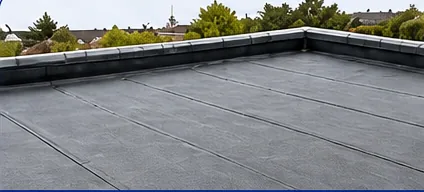
A flat roof on a shop, office block, school hall or light industrial unit does a harder job than the one on a house extension. It is larger, it carries plant and walkways, it is walked on by maintenance staff, and a leak over stock or machinery costs real money. Three families of system cover almost all of them: single-ply membranes, built-up felt, and liquid-applied coverings. Each has a different way of being fixed, repaired and kept watertight. This guide sets them side by side so that you can judge a specification when one lands on your desk.
If lifespan is your only question, the short answer on the longest-lasting commercial flat roof gets there faster.
Start with the deck and the insulation
Before comparing coverings, look at what is underneath, because it limits the choice. Commercial decks are usually profiled steel sheet, concrete, or timber and plywood. A steel deck takes a mechanically fixed system happily. A concrete deck suits bonded or ballasted systems, and a timber deck needs attention to movement and ventilation. Our guide to the best roof for a commercial building looks at the choice from the building's side.
The insulation layer matters just as much. Most modern flat roofs are warm roofs, with rigid insulation boards laid on top of the deck and the waterproof covering above, which keeps the deck warm and dry. Older roofs may be cold roofs, with insulation below the deck and a ventilated void. Falls matter as well: a flat roof is never truly flat, and tapered insulation boards are often used to create a gradient to the outlets so water does not pond. Ponding does not by itself mean the covering has failed, but standing water speeds up wear and hides leaks.
Re-covering a roof of any size also brings the energy rules into play. A roof is a thermal element, so the work may need the insulation upgraded, and your building control body decides what applies. Where the job is notifiable, we take care of the building control application.
Single-ply membranes
Single-ply means one factory-made sheet of flexible material, rolled out across the roof and joined at the seams. The common types are PVC, TPO and EPDM. PVC and TPO sheets are joined by hot-air welding, which fuses the overlap into one piece, while EPDM, a synthetic rubber, is usually bonded with adhesive or taped at the joints. Because the membrane is made in a factory, its thickness and quality are consistent, and the work on site is mainly about laying it flat, welding the seams well and forming the details at upstands (the parts of the covering turned up a wall), outlets and penetrations.
Single-ply can be installed in three ways. Mechanically fixed systems are held by fasteners through the membrane laps into the deck, which is quick and suits steel decks. Adhered systems are bonded to the insulation or deck with adhesive, which gives a smooth finish and avoids wind uplift at the fasteners. Ballasted systems hold the sheet down with a layer of loose stone or paving slabs, which spares the deck any fixings but adds a substantial load that the structure must be able to carry. Check the numbers before choosing ballast: if the new build-up adds 15% or more to the weight on the structure, approval is needed and strengthening may follow.
Single-ply is popular because it is relatively light, quick to lay over large areas, and can often be repaired by welding a patch. The weak points are the details. Seams that were poorly welded, a membrane punctured by dropped tools, or a flashing that has lifted at an upstand will let water in, and on a roof with a lot of plant the number of penetrations multiplies the risk. For a plain explanation of the material, see our short answer on what single-ply roofing is.
Built-up felt
Built-up felt roofing is the traditional multi-layer approach. Two or three layers of reinforced bitumen felt are bonded together, with the top layer, the cap sheet, often finished in mineral granules to protect it from sunlight. The layers can be torched on, where a gas flame melts the underside of the roll and bonds it to the layer below, or laid with cold adhesive or self-adhesive sheets. Modern high-performance felts use polymer-modified bitumen, which is more flexible and longer-lasting than the thin felts that gave flat roofs a bad name.
The attraction is redundancy. Several layers mean a flaw in one is covered by the next, and the system has a long track record on schools, offices and warehouses. Felt is also familiar to most roofers, which makes repairs straightforward, and it copes well with irregular roof shapes and many penetrations because details can be built up by hand.
The drawbacks are the method and the movement. Torching involves naked flame close to insulation and roof edges, so it needs strict fire precautions, hot works controls and a watch after the work finishes. Felt is also less tolerant of structural movement than a single-ply sheet, and a split at a joint or upstand usually means working out which layer has failed. Our short guide to what built-up felt roofing is goes through the layers one by one.
Liquid-applied systems
Liquid roofing systems are applied wet and cure to form a joint-free membrane. Types include polyurethane, acrylic, polyester resin and other resin-based coverings, usually reinforced with a polyester fleece in the base coat. Because there are no seams, they handle awkward geometry well: roof lights, curved profiles, plant bases and a mass of pipes are wrapped in one continuous layer without joints to fail.
Liquid systems suit two situations. The first is a refurbishment where the existing covering is sound enough to be coated, since a liquid layer over a good substrate is quicker and less disruptive than stripping it. The second is a new roof, or a roof with a lot of detail, where welding sheets around every pipe would be fiddly. They are laid by hand, so quality depends on the applicator keeping to the specified thickness, the weather being dry and warm enough to cure the product, and the substrate being clean and primed.
The limits are important. A liquid coating cannot fix a roof with a wet or rotten deck, or insulation soaked with trapped water, and putting it over those faults only hides them. Surface preparation is half the job. Our guide to liquid coatings for commercial roofs goes into where coatings work and where they do not.
Comparing the systems
| Feature | Single-ply | Built-up felt | Liquid-applied |
|---|---|---|---|
| How it is joined | Welded or bonded seams | Overlapping layers bonded together | No joints once cured |
| Best suited to | Large, plain roofs and steel decks | Roofs with many details and a track record to match | Complex shapes and sound roofs needing refurbishment |
| Main risk | Poor seams and detailing | Fire risk when torching; movement splits | Poor preparation or applied in bad weather |
| Typical repair | Weld or bond a patch | Cut out and patch with new felt | Clean, prime and re-coat locally |
What it costs and what drives the price
Price figures for commercial work are thin. The only source we hold is an informal tradesperson answer quoting around £90 to £180 or more per m² for a full commercial flat roof strip and replace. We treat that as a low-confidence guide and a typical UK range only, because the price is driven far more by the deck, the insulation thickness, access, the number of penetrations and the working hours than by the covering. A roof full of rooflights and plant will cost more per m² than a clear, plain one. Your fixed quote follows the survey.
Access is a real cost on commercial work. Scaffold, edge protection or mobile platforms can account for a good slice of the budget, and work on a trading site often needs phasing so staff and customers are not disturbed. Our short answer on roof work while a business is trading covers how we plan for that.
Plant, walkways and everything else on the roof
Commercial roofs are working surfaces. Air handling units, extract fans, solar mounting frames, cable trays and access ladders all stand on the covering or pass through it, and each one is a potential leak or a potential puncture. Plant stands should sit on supports that are flashed into the roof, not set loose on the membrane, and any pipe or cable that comes through needs a proper collar or boot rather than a smear of sealant.
Walkways deserve the same attention. If engineers visit the roof every month to service plant, the route they take should be marked and protected with purpose-made walkway tiles or a reinforced section of covering, so that boots, dropped spanners and ladder feet do not wear through the waterproof layer. Single-ply and liquid systems need this more than thick built-up felt, but all three benefit. Our guide to planned maintenance for commercial roofs shows how regular visits catch lifted seams and blocked outlets early.
Wind is the other consideration on large, exposed roofs. The edges and corners of a flat roof see the highest suction, so the fixing pattern is tighter there, with extra fasteners or a stronger adhesive bond, and the perimeter detail needs a firmly fixed edge trim. A roof that has lost a corner in a gale will often have been under-fixed at the edge or had its trim pulled off by suction.
Repair, overlay or replace
A new system is not always needed. A roof that leaks in two places may need those two places repaired, not a new covering. Where the existing system is sound but tired, an overlay or a coating might extend its life. Where the insulation is wet or the deck has failed, replacement is the honest answer. Our guide to commercial roof repair, overlay or replacement explains how to decide, and where a repair will do the job, we say so.
When we survey, we go over the roof with photographs, check the outlets, upstands, seams and penetrations, and take core samples where we need to know what is under the covering. The report shows the condition of your roof, which system we would recommend and why, and a fixed written quote. Finished work is covered by a ten-year written workmanship guarantee, and the site is left clear. For the full picture of our business work, see commercial roofing in Basingstoke, or ring 01256 213956 to arrange a survey.
