
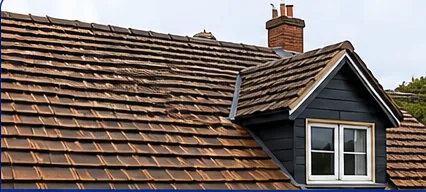
Slate is the one roof covering that can outlive the fixings holding it on. A natural slate is a stone, and a good one stays sound for generations, so when a slate roof starts to leak the sensible first question is whether the roof is failing or only its fastenings and flashings are. The answer decides whether you spend a few hundred pounds or several thousand. This guide sets out how we judge it on a survey: what to look at, what each repair really costs, where repair stops making sense, and the cases where keeping the old slates is the better and cheaper route.
Why slate is usually worth saving
A slate roof fails in two quite different ways, and only one of them means the end of the covering. In the first, the slates themselves are fine but something small has let go: a nail has rusted through, a lead flashing has cracked, a few slates have cracked from a footstep or a falling branch. In the second, the slates are breaking down. They flake in layers, turn soft and chalky, or crumble when lifted. The first kind of roof is a good candidate for repair. The second is not, however carefully you patch it.
Most of the slates on an older roof are worth far more than the fixings that hold them. Good natural slate is dense, takes almost no water and resists frost, which is why a roof laid in the Victorian years can still be shedding rain today. Throwing that away because a few corners have slipped is often poor value. Repairs also keep the character of a period house, and on a listed or conservation area home the council may expect the original slates to be retained wherever they are sound. Our page on slate roofs on period and listed homes covers that side.
The decision is not sentimental. A survey weighs what remains of the roof against what a repair would buy. If the answer is years of dry roof for a modest sum, we repair and tell you so. If the answer is a repair bill that keeps coming back, we say that instead.
What to check before you decide
Five things settle most repair or replace questions, and you can look at several of them from the ground with binoculars before anyone climbs a ladder.
The condition of the fixings
Older slate roofs were often fixed with iron or poorly protected nails. Over a century the nail rusts, swells and eventually snaps, and the slate it held slides down until it catches on the one below. Roofers call this nail sickness. A scattering of slipped slates across the whole roof, rather than a patch in one place, points to it. If the nails are failing everywhere, replacing a slate at a time only buys a season, because the next slate along has the same tired nail. Our guide to slipped and cracked slates explains how to tell a one-off from a pattern.
The condition of the slates themselves
Tap a spare slate and it should ring. A dull thud, visible layers lifting at the edges, or a surface that rubs off as grey powder means the slate is delaminating, and no fixing will rescue it. Some roofs carry a mix: sound slates on the sunny slope and tired ones on the side that stays damp under trees. We often find that only one slope needs real work.
The underlay and battens
Underneath the slates are the battens (the thin timber laths the slates hang from) and, on many roofs, an underlay or old sarking (boards or felt laid over the rafters). If these are dry and sound, a repair is straightforward. If the battens are rotten or the felt has gone brittle, the roof has to be stripped to fix them, and at that point you are paying for most of a re-slate anyway.
The lead and the ridge
Many leaks on slate roofs have nothing to do with the slates. Lead flashings around chimneys, valleys and dormers crack with age, and ridge tiles lose their bedding. Both are ordinary repairs that cost a fraction of re-covering. Always ask whether the leak comes from the covering or from the details around it.
The roof structure
A sagging ridge, bellied rafters or a damp, dark loft ceiling suggest trouble below the slates. Slate is heavy, and a tired structure may need attention whatever you decide above it.
What repairs actually cost
Costs below are typical UK ranges from published guides, for orientation only. Your fixed quote follows the survey.
| Job | Typical UK range | What drives it |
|---|---|---|
| Replacing a single slate | £100 to £250 labour, plus £5 to £25 for the slate | Access and whether the slate matches |
| Tower or scaffold for access | £300 to £800 | Height, number of elevations, pavement licence |
| Re-covering in natural slate | £120 to £180 per m² | Pitch, detailing, new battens and underlay |
| Re-covering in man-made slate | £90 to £130 per m² | The same drivers, on a lighter, cheaper covering |
Notice how much of a small repair is access. A single slate costs a few pounds, but reaching it safely can cost more than the slate and the labour together. That is why one slate at a time is rarely the cheapest route. If three or four separate spots need attention, doing them in one visit shares the access cost between them, and a good roofer will batch the work so you pay for the scaffold or tower once.
Where repair stops making sense
There is a point on every slate roof where the repair bill passes the sense of keeping going. We watch for four signs.
- Slipped or cracked slates keep appearing in new places after each repair, which points to failing nails across the whole slope.
- The slates are delaminating or crumbling, not just cracked by impact.
- The battens are rotten or the underlay has perished, so any repair means lifting large areas anyway.
- A single slope needs more than a modest share of its slates replaced.
On the last point there is a useful regulatory marker. The Planning Portal treats a repair as exempt from a building control application only while it touches a small enough share of the house: under a quarter of the whole building shell and under 50% of the roof itself. Cross either line and approval is required, and the insulation across the entire roof may have to be brought up to current standard. So a very large patch repair can end up carrying the same obligations as a re-roof. The Planning Portal sets out the test in its guidance on re-roofing and Building Regulations, and your building control body confirms how it applies to your house. We handle that side of the paperwork where the work is notifiable.
When a roof does reach that point, re-slating is the honest answer. We describe how the job runs, stage by stage, in our guide to re-slating a roof, and the cheaper alternatives, such as reusing the good original slates, in the page on reclaimed slate.
The middle route: strip, repair and re-lay
Between a patch and a full new covering sits a third option that suits many period roofs. The slates come off, the sound ones are sorted and set aside, the battens and underlay are renewed, and the original slates go back on with new copper nails or stainless hooks, topped up with matching reclaimed slates where some have failed. You keep the look, the weight and much of the material, and you cure the cause of the leaks, which is the fixing and the layer beneath it.
This costs more than spot repairs and less than new slate. It also makes sense where the slates are good but the roof has been neglected for years. The one thing to watch is that sorting needs honesty: slates that ring clear go back, and slates that sound dull do not. Reusing marginal slates to save money simply moves the leak to next winter.
Timing a repair around the weather
Slate roofs rarely fail in a dramatic way. They let in a little water at a time, and the damage builds quietly in the loft: a damp patch on the felt, a darkened rafter end, a ceiling stain that appears after a week of rain and fades in a dry spell. Because the harm is slow, it is tempting to wait. The trouble is that wet timber and wet insulation do not dry out between storms the way a roof surface does, and a cheap slate repair left for two winters can grow into a rotten batten run or a replaced section of ceiling.
Autumn is the sensible deadline. Slipped slates that were fine in summer are exposed to the first long run of gales and driving rain, and a slate that is hanging by one corner can fall without warning onto a path or a car. If you can see a slipped slate from the garden, treat it as a safety problem as well as a leak. We prioritise calls about active leaks and will make the roof safe first, with the permanent repair planned for a dry day. Repairs are also cheaper to schedule in settled weather, since slating in rain is slower, riskier and sometimes impossible.
Between visits there is one small job you can do from the ground. After heavy rain, look at the loft with a torch, if it is safe to enter, and check the underside of the slope for wet patches and the floor for drips. Photograph anything you find. That record helps us trace the entry point, because water often runs a long way down a rafter before it drops.
How we help you decide
Our first visit is a free survey, with photographs of your own roof from the ridge down: the slipped corners, the rusted nail ends, the cracked lead, the delaminating edges. You see the same evidence we do. The written report separates three things, namely what is leaking today, what is likely to fail soon, and what can wait. Then you get a fixed written quote for the option we would choose, and if repair works we say so, even where a bigger job would pay us more.
Whatever route you take, the work carries a written 10-year workmanship guarantee, we leave the site clear and carry the waste off. If a repair is all you need, our slate roofing in Basingstoke service covers that too, and ring 01256 213956 when you want a time for the survey, or message us on WhatsApp.
