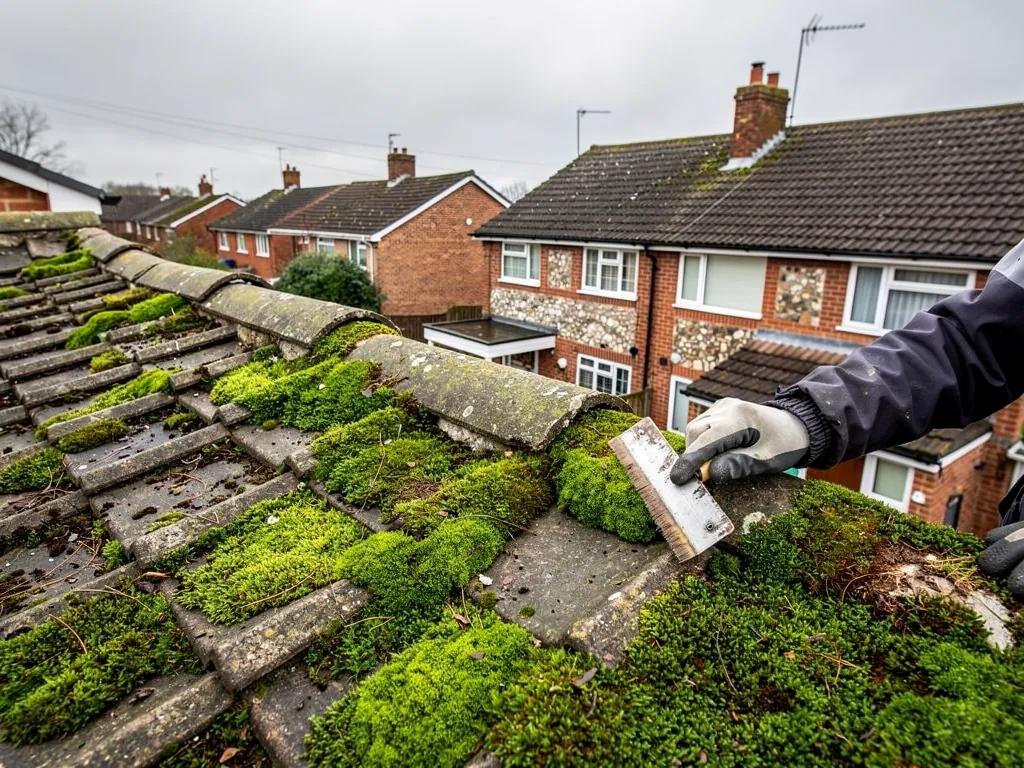
Estate agents talk about kerb appeal for a reason. Buyers form a view of a house from the pavement and the car, before they have seen a single room, and the roof fills a large part of that view. A roof streaked with black and furred with green moss tells a buyer the house has been neglected, whether or not it has. A surveyor reading the same roof will be looking for evidence, not impressions. This guide explains how cleaning fits into the sale of a house, what to do first, and the cases where the right move is to do nothing.
What buyers and surveyors actually see
A buyer standing on the drive sees colour, line and condition. Moss and black streaks make a roof look older and tired. A clean, even roof makes a house look cared for. That is an impression, but impressions drive first offers, and a house that looks well kept starts the viewing in a better place.
A surveyor sees evidence of how the roof is behaving. They look for slipped or cracked tiles, sagging lines, failing ridge mortar, blocked gutters and signs of leaks. Heavy moss does not mean the roof is failing, but it prompts a closer look, and a note in the report. Many homebuyer surveys flag a mossy roof with a recommendation to have it checked. If the report says "roof covering in poor condition, seek specialist advice," the buyer may ask for a price reduction. The buyer's side, when a survey has flagged a roof, is in this guide for homebuyers, which covers the buyer's side of this, and the answer on renegotiating a house price over roof defects shows how it plays out.
Does cleaning add value?
We will not promise a figure, because none can be sourced and sale prices depend on many things. What can be said is narrower. A visibly neglected roof may lead to lower offers or a request for a reduction, and a clean roof removes one reason for that. Whether the effect is worth the cost is a decision for you and your agent, and our short answer on whether cleaning a roof adds value goes through the arguments. Published UK cost guides report typical prices for hand moss removal with biocide of £748 for a small roof, £863 for an average one and £978 for a large one, and £553, £638 and £723 for pressure washing. Your fixed quote follows the survey. Compare that spend with what a buyer's price request over a roof would cost you.
Survey first, clean second
The order matters. If you clean a roof that has problems, you may reveal them during the sale, or hide them in a way that causes trouble later. A better route is to have the roof looked at before it is cleaned and before it goes on the market.
A roof survey tells you what you are selling. It identifies slipped or broken tiles, failing ridge or verge mortar, flashings, the state of the felt where visible, and the gutters. It lets you repair the small things at your own pace, with your own roofer, and with a photographic record. Our answer on whether to survey the roof before selling explains the case, and a record of repairs in your sale pack tells a buyer that issues were dealt with.
The same visit tells you what level of cleaning is needed. On a sound roof with moss and streaks, cleaning and a biocide treatment may be all that is needed. On a roof with other faults, a minor repair first will avoid a clean being undone by a leak.
Repair what a surveyor would flag
Some defects are cheap to put right and expensive to be asked about. Check these before the roof is shown.
Ridge and verge mortar
Crumbling mortar along the ridge or gable edge is easy to see from the ground and easy to flag. A repair is usually a small job. Two of our guides, on ridge tiles that are failing and repairing a gable verge, explain what to look for.
Slipped or cracked tiles
A handful of tiles out of line are a prompt for a closer inspection. Replacing them is simple and costs little compared with the doubt they raise.
Gutters, fascias and downpipes
Overflowing gutters and stained walls are visible from the viewing path. Clearing and re-fixing gutters is cheap, and how moss ends up in the drainage is worth a read first.
Flashings and chimney work
Lifted or cracked lead and failing chimney pointing are classic items in survey reports. If you know about them, a repair and a receipt are better than a surprise.
What kind of clean suits a sale
The method matters more than the speed. Pressure washing gives a bright result in a day, and risks stripping tiles, loosening mortar and forcing water into the roof space, all of which may show up in a survey after the sale is agreed. The reasons are laid out in our guide to high-pressure washing. A hand clean with a biocide treatment is gentler and more lasting, though the result develops over weeks. That is a point for timing: if you plan to market the house in a month, treat the roof now, not the week before photographs.
The treatment, the covering and the weather all affect speed, and our comparison of moss removal methods can help you decide. For a roof in a conservation area, check with the council before changing anything beyond cleaning.
| Situation | Sensible step before sale |
|---|---|
| Moss and streaks on a sound roof | Hand clean and biocide treatment, weeks before marketing |
| Moss plus cracked ridge mortar | Repair the ridge first, then clean |
| Light lichen on an old slate or clay roof | Leave alone, perhaps clear gutters |
| Roof near the end of its life | Survey, get a written opinion, disclose honestly |
| Short deadline, thick moss | Hand removal now, treatment to finish the job |
Timing the work around a sale
A sale has a calendar, and roof work needs to fit it. The ideal order is a survey several weeks before listing, repairs next, then cleaning, then photographs once the roof has had time to show the result. Listing photographs taken in grey winter light on a mossy roof are hard to retake, so it pays to deal with the roof before the agent visits. If you are already under offer, the buyer's survey is coming, and a visible repair and a clean roof reduces the scope for questions.
If the weather will not allow a biocide treatment to be applied properly, we can do hand removal of the worst growth now and treat later. We will not promise a result in a week that takes six.
What to tell the agent and the buyer
Keep it simple and factual. Tell the agent that the roof has been surveyed, name what was found and what was done, and keep the photographs and the written quote or invoice to hand. If a buyer asks about moss, you can say the roof was treated on a given date and describe the method. A buyer's surveyor is helped by clear records, and records show that nothing is being hidden. If repairs came with a written guarantee, pass a copy on, because the new owner will value it.
If a defect remains, say so. A roof near the end of its life is not a secret a surveyor will miss. A seller who can say how long a repair or a re-roof would take, and roughly what it would involve, is in a stronger position than one who changes the subject.
A word on the rest of the house
Buyers look at the roof together with the things that sit on it and around it. A chimney with crumbling pointing, a broken pot, a wonky aerial, a stained fascia or a sagging porch canopy tell the same story as a mossy tile. If you are tidying the roof, spend a few minutes looking at those items from the pavement. Fixing the cheap ones in the same visit, while access is in place, is where sharing a scaffold or tower saves money. We note them on the survey and price them as separate lines, so you can decide which to do before the sale and which to leave.
Photographs and paperwork
Before any work starts, photograph the roof from the front and sides. After the work, photograph it again from the same positions. Ask your roofer for a dated report with photographs of the covering, ridge, verges, gutters and any repairs. These records answer a buyer's questions in seconds and cost nothing to keep. Put them with the guarantee, the invoice and any building control certificate if larger work was done.
When not to clean
Cleaning is not always sensible. If the roof is near the end of its life, a clean is a cosmetic cost on top of a bigger question, and a buyer's surveyor will see through it. Honest disclosure and a written roofer's opinion often do more for a sale than a bright surface. If the growth is light and the roof sound, you may be better to leave it, since the money is small but real. An old slate or clay roof with lichen can look better with its patina than scrubbed. And if you have a very short timeline, a quick rinse that damages tiles is worse than none.
Your legal duties as a seller are for your solicitor to explain, and we give no legal advice. As a practical point, if you know about a defect, record it and what you did about it, and be ready to answer questions.
How we work with sellers
Our free survey photographs the covering, the growth, the ridge, the verges and the gutters, and tells you which are worth attention before a sale and which are not. The quote that follows is one fixed price, and the report is yours to share with your agent or a buyer. If repair beats replacement, we say so, and we say so when the roof has years left. Our written guarantee on workmanship runs for ten years, and we leave the property tidy. Read more on the roof cleaning in Basingstoke page. If a sale is coming up, tell us the date when you call 01256 213956 so we can plan the work around it.
