
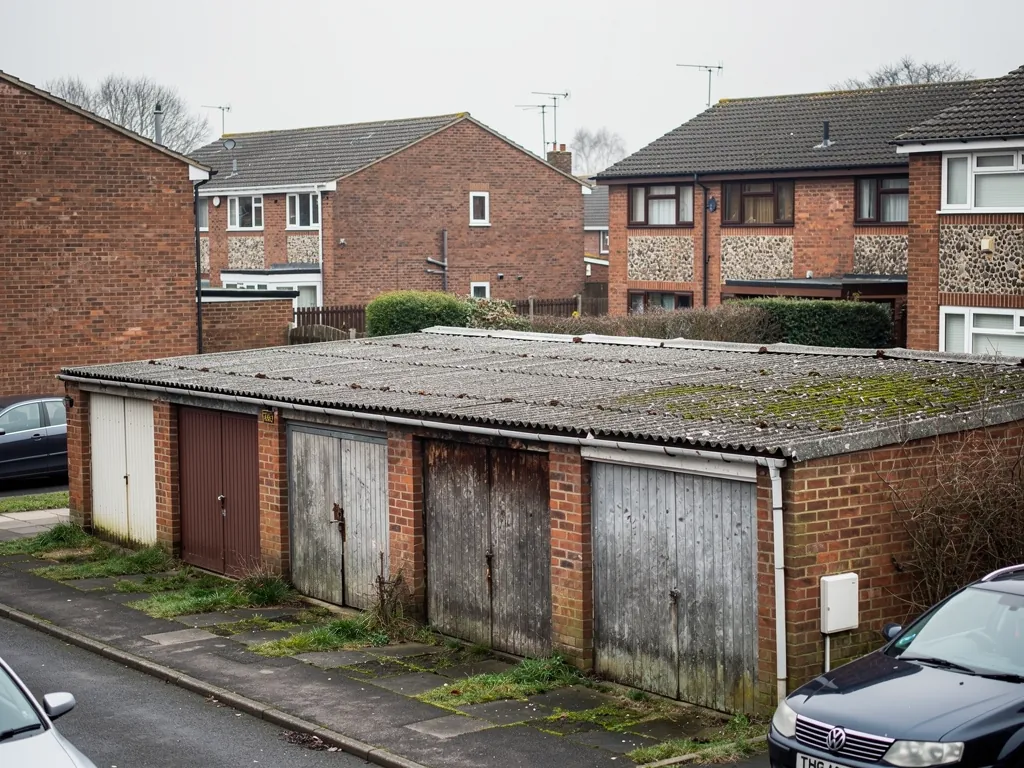
Replacing a garage roof is one of the few roofing jobs where the choice of material is genuinely wide open. A house roof is usually tiled or slated to match, but a garage can take anything from a rubber membrane to a clay-tiled pitch. The best choice depends less on taste than on the garage in front of you: how steep the roof is, what the walls and frame can carry, whether the building is attached, and whether the space inside is a store, a workshop or a future room. This guide compares the main options one by one, then offers a way to choose between them.
Start with the pitch and the frame
Two facts about your garage narrow the field before you look at a brochure. The first is pitch, the angle of the roof. A flat or near-flat roof needs a continuous waterproof skin such as rubber, felt or GRP, because overlapping tiles and sheets rely on gravity to shed water and leak when the slope is too shallow. A properly pitched roof opens the door to tiles, slates and sheets. Each product has a minimum pitch stated by its maker, and it is not negotiable.
The second is the frame. A prefab garage with thin concrete panels or a light timber frame was built for a light covering, and a heavy one needs checking. A brick garage with solid walls and a stout roof can carry more. Weight matters twice: for the structure, and for building control, which wants to know if the new covering is much heavier than the old. Our guide to converting a flat garage roof to pitched covers what changes when the frame itself is replaced.
EPDM rubber membrane
EPDM (ethylene propylene diene monomer) is a synthetic rubber sheet, supplied in large widths and bonded to a boarded deck with adhesive. A single garage roof can often be covered in one piece, so there are no seams across the middle. It is light, flexible and tolerant of the small movements of a timber deck, and it is one of the most popular choices for flat garage roofs today. A cost guide that looks at single garages specifically reports a fitted EPDM roof between £1,200 and £2,500. Per square metre, the ranges quoted by cost guides run from £70 to £120, depending on the source. Treat these as orientation, and know that your fixed quote follows the survey.
Weak points are punctures and edges. Grit under a shoe or a fallen branch can cut the sheet, and the details at the walls and edge trims depend on the installer. For a longer discussion, see our answer on whether EPDM is good for a garage roof.
Felt: mineral roll and torch-on
Felt is the budget choice. Mineral-faced roll felt, nailed or bonded to a boarded deck, is the basic material for sheds and many older garages. A heavier, reinforced bitumen system is melted onto the deck in two or three layers and gives a better roof. Felt is easy to repair and quick to lay, but it generally has the shortest life of the common coverings, and it needs more attention to the laps and edges. Our guide to torch-on felt roofing sets out how the system is built and where it is wise to avoid a naked flame, as a garage with a timber frame and old boards can be a fire risk.
GRP fibreglass
GRP is glass-reinforced plastic. Resin and glass matting are laid wet over a boarded deck, cure into a hard shell and are finished with a coloured topcoat. It is jointless, so it suits roofs with awkward shapes, upstands or several penetrations, and it takes occasional foot traffic better than rubber. The deck needs to be dry and rigid, because a flexing deck will crack the laminate, and the work is weather dependent. The price is typically a little higher than EPDM.
Profiled sheets
Profiled sheets, corrugated or box-profile, are the modern heirs to the old garage roof. Today's versions are made of coated steel, fibre-free cement, or bitumen-impregnated board, and they are fixed across purlins in a low-pitch frame. They are light, fast to fit and cheap, and they suit a simple garage or workshop where appearance matters little. The common drawbacks are noise in rain and condensation underneath in cold weather, which is why insulated or anti-condensation sheets are available. Our guides on which roofing sheet is best and condensation under a metal roof explain the choices and fixes.
Tiles and slates
If the garage has a proper pitched frame, tiles or slates are possible. Concrete tiles are the most affordable and the heaviest. Clay tiles and natural slate cost more and have a longer record. Man-made slate is lighter, and a tiled garage roof matches the house. The price is a full pitched roof's worth of battens, underlay, tiles and ridge, and it is the most expensive of the options here. It is also the most durable, and a tiled roof that is correctly built needs less attention over time. Ridge, hip and verge components should be fixed mechanically, in line with BS 5534, and not left to mortar alone.
Other options worth knowing
Liquid-applied coatings can renew a sound roof surface, but they are not a substitute for a covering on a failed deck. Felt shingles suit small pitched garden buildings, as our guide to felt roof shingles explains. Sedum and green roofs are possible on a strong frame, though the weight is substantial and the structure must be designed for it. Clear polycarbonate sheets let light into a workshop but are not insulated and can overheat.
| Covering | Pitch needed | Weight | Best suited to |
|---|---|---|---|
| EPDM | Flat or low | Very light | Flat garage roofs, light frames |
| Felt | Flat or low | Light | Budget re-roofs, simple garages |
| GRP | Flat or low | Light | Awkward shapes, some foot traffic |
| Profiled sheets | Low pitch, per maker | Light | Workshops, stores, plain garages |
| Tiles or slate | Per maker, steeper | Heavy | Pitched frames, garages matching the house |
Cost over the life of the roof
A fair comparison looks at cost per year of service, not the invoice alone. A felt roof that costs less at the start but needs replacing sooner can end up costing more over a long ownership than an EPDM or GRP roof that outlasts it. A tiled roof costs the most at first, but it can serve for a long time with only minor repairs. Where a sale is likely within a short time, the cheaper covering is often the honest choice, and where the garage is part of a home you intend to keep, spending more on a longer-lived roof is usually sensible. Our garage roof replacement cost guide sets out the published ranges and what moves them.
Edges, fixings and rainwater
Whatever covering you pick, the roof is only as good as its edges. Trims at the eaves and verges should throw water clear of the walls. Fixings in sheet roofs need sealing washers and the right fasteners for the frame, because a loose screw is a leak. Upstands at a house wall need proper flashings, and gutters need brackets that are fixed to something sound. Many garage leaks that are blamed on the covering turn out to be a failed edge or a gutter that overflows into the wall. A roofer who talks about the detail as well as the product is worth listening to.
Noise, weather and appearance
Materials behave differently in weather. Sheets drum in heavy rain, tiles and a boarded membrane are quieter, and a thick insulated sheet is somewhere between. Dark coverings absorb heat in summer, which matters if the garage is used as a workshop. Frost and wind stress different parts of each system: shingle-like tiles lift in gales unless fixed properly, and thin membranes at edges can flap if they are not bonded well. As for appearance, a garage that faces the street usually deserves a covering that looks right, and one that sits behind the house can be chosen purely on performance. Colour choices exist in most systems, from grey and black membranes to red tile and slate finishes.
Asbestos on an old garage
If your garage has the old corrugated grey sheets, treat them as asbestos cement until tested. They can be removed carefully, whole, under the HSE rules, or sometimes left in place and covered. That choice interacts with the material you want next: an overlay needs a frame strong enough to carry two roofs, and a lightweight replacement suits a frame that was built for sheets. Our guide to asbestos garage roof removal covers it.
Insulation, use and the future
The use of the garage affects the material. A store for bikes and bins is fine with a basic covering. A workshop benefits from an insulated roof that cuts condensation and holds heat. A garage that may become a room should be roofed with that in mind, as insulation above the deck can be added during the re-cover, sparing you a second disturbance later. See our guide to the garage conversion roof.
How to choose
Ask five questions. How steep is the roof? What can the frame carry? How long will you keep the building? Is it near the house, where looks matter? And is the space inside likely to change? A flat brick garage kept for years usually points to EPDM or GRP. A simple store you intend to sell with the house might be fine with felt. A pitched frame you want to match the house points to tiles or slate. A low-pitch workshop suits sheets.
We survey the roof and the frame before recommending anything, and tell you which materials suit your garage and why. A fixed written quote follows, and our workmanship on the new roof is covered by a ten-year written guarantee. The full range of garage work is described under garage roofing, and a call to 01256 213956 starts the process. Whichever covering you lean towards, ask for the survey photographs, because they let you compare quotes against the real condition of the deck, the frame and the edges rather than against a guess. If something other than the first option turns out to suit the building better, we will say so.
