
Repointing is the job of cutting out the crumbling mortar between the bricks of a chimney stack and filling the joints again with fresh mortar. It is the commonest repair we carry out on chimneys, and it is also the one that is easiest to do badly, because a neat-looking finish can sit on top of joints that were never raked out properly. This guide explains what the work involves from first look to last brush-down, what the mortar choice means for the life of the stack, when repointing is the wrong answer, and what it typically costs in the UK.
Why chimney mortar fails first
A chimney stack is the most exposed masonry on a house. It stands clear of the roof on all four sides, so rain is driven into it from whichever direction the weather comes from, and there is no roof or wall to shelter it. Frost then does the rest: water held in the mortar freezes, expands and breaks the surface away a little more each winter. Mortar is meant to be the sacrificial part of a wall, softer than the brick so that it wears first and can be renewed. On a stack that point comes sooner than anywhere else on the house.
The inside of the stack adds its own wear. Flue gases from a past gas or coal fire are acidic and damp, and they can attack the mortar from within. A stack that has been disused for years can also stay wet, since there is no warm flue to dry it out. The result is mortar that has eroded back from the brick faces, sometimes by a centimetre or more, leaving the bricks edge-on to the weather with nothing to shed the water. You can often see it from the garden as dark, open lines between the bricks, or as grit on the path below.
How we check whether repointing is the right job
We do not recommend repointing until we have been up and looked. The aim is to decide whether the bricks can hold a new mortar joint, and whether the problem is only in the joints. We test the mortar with a tool to see how deep the decay goes, tap the bricks to hear whether they are sound, check that the stack is plumb, and look at the flaunching and flashings, since repointing a stack with a failed flashing will not stop the leak.
If the bricks are spalling, which means their fired faces are flaking away, or the stack leans, repointing may be the wrong repair. Fresh mortar on a failing column buys little time, and the money is better spent on the proper fix. Our guide on whether to rebuild or repair a chimney stack explains where the line falls. When repointing is right, we say so plainly and show you the photographs of the joints that justify it.
The repointing job, step by step
The method is simple on paper, but quality depends on discipline at each stage. A typical stack goes like this.
- Safe access. The stack is reached from a scaffold or tower, or a roof ladder with a safe working platform, depending on the roof. Work at height is not done from a ladder alone.
- Raking out. The old mortar is cut out of every joint that needs it, to a depth of about twice the joint width, so there is solid, clean brick on both sides for the new mortar to grip. We use hand tools on soft or old brick and take care not to chip the arrises, the sharp edges of the bricks. A power tool can damage the brick edge and make the joint wider, which is why we choose the tool for the brick.
- Cleaning out. The dust and loose grit are brushed and blown out of the joints. Mortar put on top of dust does not bond.
- Wetting. The brick is dampened so it does not pull the water out of the fresh mortar too fast, which would leave a weak joint.
- Filling. New mortar is packed into the joint in layers, deep joints first, so there are no hollows behind the surface. It is pressed in with a pointing iron, not smeared across the face.
- Finishing. The joint is shaped to a profile that sheds water. Flush and slightly recessed (bucket-handle) joints are common on chimneys. A deep recessed joint holds water against the brick, and a flat weathered joint sheds it.
- Aftercare. The face is brushed down once the mortar has stiffened, and the new work is kept from drying too fast in sun or being caught by frost.
Because the stack is high, the timing of curing matters more than it would at ground level. Fresh mortar needs mild, damp-free conditions. We pick the working days for that, and not just for convenience. Our answer on how long chimney repointing takes gives a practical sense of the time involved.
Lime or cement: choosing the mortar
The single most important decision in a repointing job is the mortar. The rule is that the new mortar must be no harder than the brick. If it is harder, moisture can no longer escape through the joints, so it leaves through the brick faces instead, and the bricks spall. That is why a well-meant cement repoint of an old soft brick stack can cause more harm than the neglect it replaced.
Modern bricks from the 1960s onwards are fired harder and can usually take a stronger mix. Older bricks, such as those on Victorian and Edwardian houses and on farmhouses and cottages in the villages around Basingstoke, are softer and porous. They need a lime-based mortar, which is more flexible and lets the stack breathe. The colour and grain of the sand matter as well, since a mismatch is visible for years. The comparison is covered more fully in lime or cement mortar for chimneys, as a short answer page.
Lime mortar is slower to set and more sensitive to the weather, which is another reason to schedule the job for a mild spell. For a listed building or a home inside a conservation area, the mortar and the finish may need consent, so check with the council's conservation officer before the work is planned.
Repointing is not the whole chimney
A stack that needs repointing often needs a few related jobs at the same time, because they all fail for the same reason. It is cheaper to do them together, with one scaffold, than to come back separately.
- The flaunching, the sloping mortar bed at the top that holds the pots, is often cracked or has lifted and lets water in around the pot.
- Pots can be loose, cracked or leaning, and a cracked pot is a falling hazard as well as a route for rain.
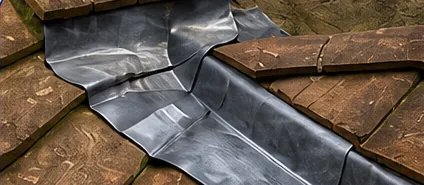
- The lead flashing, the metal strip that seals the stack against the roof, can lift or split. Lead is a separate trade, and we handle it as part of the same visit.
- Individual bricks that have lost their faces may need cutting out and replacing before the joints are filled.
If any of those are in poor condition, repointing the stack on its own gives only a partial result. We list each one separately in the report so you know which parts are fine and which need work.
How often it needs doing, and what it costs
There is no single interval that suits every stack, since exposure, brick type, mortar and flue use all change it. A stack in an open position on a hilltop village gets more weather than one tucked between neighbours in a town street. Our answer on how often a chimney should be repointed covers what to look for in your own case. A look from the garden every year or so, ideally with binoculars, is a sensible habit.
On cost, the typical UK range reported by one cost guide for chimney repointing is £450 to £1,200, while another gives about £750 as a typical job. Those figures cover a straightforward stack, and scaffold, extra brick replacement, lead work or a tall multi-flue stack all push the price up. These are national figures for orientation, and the fixed quote only comes once we have been up and looked. For a wider look at what goes into a chimney bill, see our page on chimney repair costs.
Common mistakes we put right
A lot of the repointing we are asked to look at is a repair of an earlier repair. The faults repeat, and knowing them helps you judge any quote, ours included.
The first is pointing over the top of the old mortar without raking it out. It looks tidy for a season, then the thin skin of new mortar falls away in sheets because it never bonded to anything. The second is smearing mortar across the brick faces, which hides the joint line, traps water against the brick and leaves a grey stain that never weathers away. The third is using a strong cement mix on soft brick, which sets harder than the brick around it and drives the damage into the brick faces over the following winters.
A fourth is working in the wrong weather. Mortar laid in hard frost or strong sun can fail before it cures, and a stack that gets rained on straight after pointing can have the fresh joints washed out. The last is repointing a stack whose real fault is somewhere else. A cracked flaunching or a split flashing lets the water in, and joints that were fine get blamed. The cure is to find the source of the water before touching the mortar.
If you already have a repoint that is failing, tell us when it was done and what it looked like at the time. It helps us see whether the fault lies with the materials, the preparation or the weather, and whether the stack can take a second repoint or needs something firmer.
What you get from us
We begin with a free survey. We go up, probe the joints, test the bricks and photograph each face of the stack, so you see its real state before you decide anything. The report separates what needs doing now from what can wait, and the price is a fixed written quote. Where repointing is enough, we do not suggest a rebuild.
The finished work carries our written 10-year workmanship guarantee. We clear the scaffold and rubble away at the end. To book a survey, phone 01256 213956 or use WhatsApp, and you can read about the rest of our stack work under chimney repairs in Basingstoke.
