
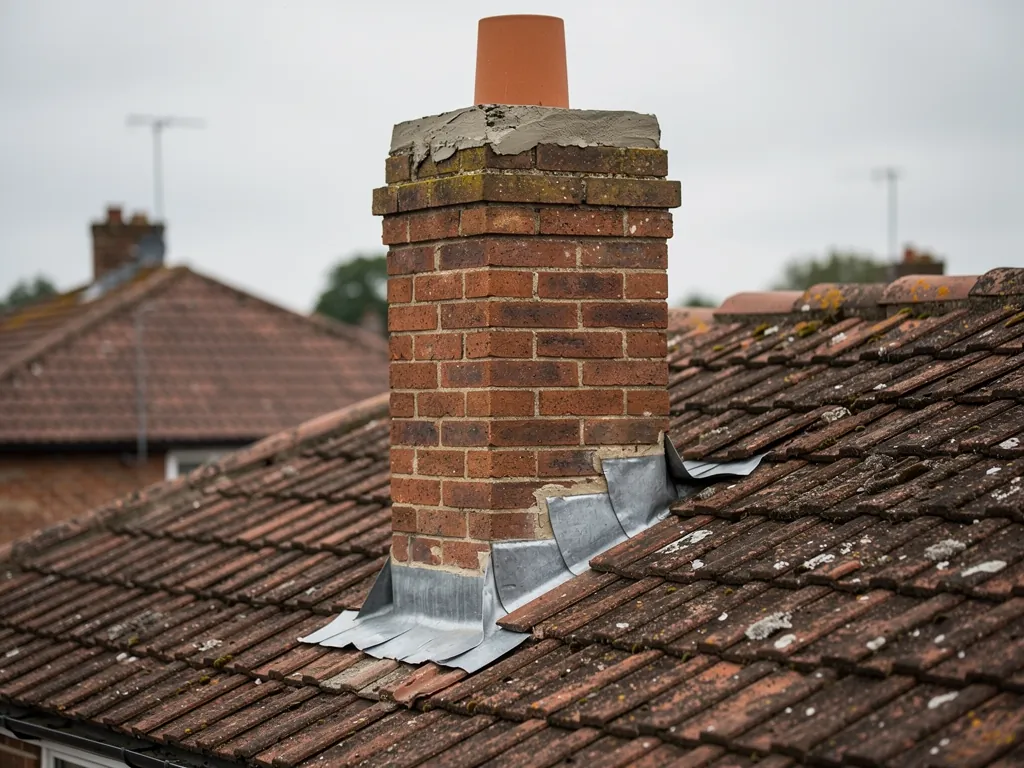
A chimney stack that no longer serves a fire is easy to resent. It shades the loft, it needs pointing every so often, and its flashing is one of the likeliest places for a roof to leak. Removing it sounds like the tidy answer. Sometimes it is. But a stack is part of the structure, it is often shared with the house next door, and the hole it leaves in the roof has to be closed properly. Here is how a stack removal works, what the rules expect, and what to weigh first.
Stack, breast and flue: three different things
People use "chimney" for the whole run, but a removal job can mean very different amounts of work depending on which part is going. The stack is the brickwork you see above the roof. The chimney breast is the projecting column of brickwork inside the room, which rises through the floors. The flue is the hollow passage inside both, and it is often lined with clay pipes or a rendered parge coat. The pots on top, the flaunching (the sloping mortar bed that holds the pots and throws water off) and the lead flashings where the stack meets the slope belong to the stack end of the run.
Removing only the part above the roof leaves the breast and the flue inside the house untouched. Removing a breast means taking out masonry that may be carrying the weight of the chimney above it, so the two jobs need different thinking. We cover the room side in our answer on taking out a breast while keeping the stack. This page is about the stack at roof level, and about taking it down to or below the rafters.
Why people remove a stack, and when they should think twice
The usual reasons are practical. The stack has started to lean or the brickwork is spalling (the faces of the bricks flaking away after frost). The pointing is gone and the owner has been quoted for a rebuild. Or an extension, a loft conversion or a run of solar panels would be simpler without it. All are fair reasons.
The reasons to pause are just as practical. A stack that is sound and well flashed costs very little to keep, and a repair is usually the cheaper route. If the question is really "can I get rid of this expense", compare it with the sourced repair figures further down. A stack is also a feature of the elevation, and on many period streets in Basingstoke, Winchester and Newbury the line of stacks is part of what the street looks like. Where the house is a listed building, or sits inside a conservation zone, consent may be needed before a stack comes down, and the council's conservation officer is the person to ask. Our guide on whether to remove a chimney you do not use goes through the decision from the owner's side.
There is one more reason to be careful. A stack often braces the gable or the party wall it sits on, and it sometimes carries a share of the roof load. Nobody should assume it is decoration until someone has looked at how it is built into the house.
Building Regulations, planning and the neighbours
Because removing a stack or a breast can change how the building carries its loads, treat it as work to discuss with a building control body before anything is knocked down. That can be your council's building control team or a registered building control approver, the name private inspectors have used since April 2024. They will tell you whether an application is needed and what they want to see, which often means a structural calculation for any support that replaces the masonry. Do not take our word, or any builder's word, as the final say on this. Ask the people who sign it off. Where the work is notifiable, we take care of the paperwork with that body for you.
The roof end can be a separate question. If the removal takes a large patch of covering with it, the Planning Portal thresholds on re-roofing come into play: repairs or re-covering do not normally need a building control application where they affect less than 25% of the building envelope and less than 50% of the roof. Closing the hole where one stack stood is nowhere near those figures on an ordinary house, but the point is worth knowing for a bigger job.
Planning permission is a different matter and a short one. Whether a given removal needs it depends on the building and where it stands, so check with your council's planning team, especially for a listed building, a conservation area or a property with an Article 4 direction. Our answer on planning permission to remove a chimney sets out the questions to ask.
Then there are the neighbours. In terraces and semis the stack is very often shared: one stack, two sets of flues, one on each side of the party wall. You cannot simply take away your half. The stack must be left stable, the neighbour's flues must stay sound and ventilated, and the Party Wall etc. Act 1996 may apply, so speak to your neighbour early and check the position before work starts. Our page on shared chimney stacks and who pays explains how those arrangements usually work in practice.
How a stack comes down
The sequence matters more than the speed. Work starts with access: a scaffold or a tower and a proper edge protection platform, because nobody should be working on a ridge-level brick structure from a ladder. Pots and cowls come off first and are lowered, not dropped.
The brickwork is then dismantled from the top in courses, by hand, with the debris passed down in sacks or a chute to a skip. Machines and big hammers are the wrong tool: vibration travels down through old brickwork and can loosen a party wall or crack ceilings below. Where the stack is shared, it is taken down to a level agreed in advance and the neighbour's side is left properly supported, usually with a cut-back that is finished with a sloped bed of mortar so water runs off.
Below the roof, the loft is inspected. Soot, loose mortar and the flue lining all have to be dealt with, and the remaining flue should either be sealed and ventilated, or taken out with the stack, depending on what is left beneath. The decision comes from what we find, not from a standard routine.
If you are keeping the breast and the lower part of the flue, a capping detail with a vent is how a disused flue stays dry. Our note on capping a disused chimney covers that approach, which is a legitimate halfway house between keeping the whole stack and removing it.
Closing the roof behind it
This is the part owners tend to overlook. When the stack goes, the roof has a hole in it, and the rafters around that hole were arranged to frame the stack, not to support a normal slope. A carpenter has to trim in new timbers, often a pair of trimmers and a short run of infill rafters, so the roof is properly supported where the stack stood.
The covering then goes back in. On a tiled roof that means new battens, new underlay (the waterproof sheet beneath the tiles), and tiles that match the surrounding roof in age and colour as closely as can be managed. On slate the matching is harder, because salvaged slates are needed to avoid a bright patch. If the old lead flashings and the soakers (the folded lead pieces that sit under the tile edges) have gone, they go with it. Everything must lap correctly so water passes over each layer, and the new section should be fixed as the original was, with nails and clips and not mortar alone.
If the stack stood on the ridge, the ridge itself has to be completed across the gap with mechanically fixed ridge tiles. If it stood part-way down the slope, the new area is a patch of ordinary roof, and a sloppy patch is the commonest cause of a leak after a removal. A wet patch on the ceiling below a former stack a winter later almost always traces back to this junction.
What it costs
We do not have a sourced national figure for removing a whole stack, and we will not make one up. The sourced ranges are for the work around it. Typical UK ranges reported by cost guides are £450 to £1,200 for chimney repointing, while general chimney repair is reported anywhere from £500 up to £2,000, averaging about £750. For lead around a stack, one guide gives a range of £350 to £920, with an average of £570. Your fixed quote follows the survey.
These figures are useful as a comparison. If the cheaper fix on your stack is repointing and a new flaunching, removal has to justify itself on grounds other than price. What moves a removal quote is clear enough:
| Cost driver | Why it changes the price |
|---|---|
| Height and access | A tall stack on a steep roof needs more scaffold and slower, safer dismantling |
| Shared or single | A shared stack needs neighbour agreement and a careful cut-back |
| Structure below | If the breast or gable relies on the stack, a support or calculation may be needed |
| Roof covering | Slate and clay tiles cost more to match and patch than concrete tiles |
| Inside work | Flue sealing, loft clearance and ceiling repairs add labour |
| Waste | Brick and mortar are heavy, so skip size and carry-down time count |
Scaffold is often the largest single item on a short job. A reported range for roofline scaffold hire runs from £200 for one side of a bungalow to £2,600 for four sides of a two-storey detached house, and a chimney job normally needs far less than the top of that range, though the principle holds: access is not free.
The risks, and the alternatives
The risks of a bad removal are not dramatic, they are slow. A poorly trimmed roof sags a little. A weak patch lets water into the loft. A neighbour's flue loses its support and starts to damp their wall. A removal that was not discussed with the building control body turns up as a question when you sell. Nesting birds and bats are protected, so work on a stack may have to be timed or checked first.
The alternatives are worth putting on the table before you decide. A leaning or crumbling stack can often be rebuilt from the roofline, which keeps the look and the support. Our rebuild or repair guide covers when that makes sense. A stack that is only tired may need repointing and a new flaunching. A stack you never use can be capped and ventilated. Only when none of those suits the building, or you want the space for good, does removal come out ahead.
Our free survey looks at the whole stack from the roof, the loft and the neighbouring side where we can see it, with photos of your own chimney. The quote comes back in writing at a fixed figure, and if a repair will do we tell you so. If you do go ahead with chimney work in Basingstoke, the work carries our 10-year written workmanship guarantee and we clear the site and take the rubble away. To book, ring 01256 213956 or message us on WhatsApp.
