
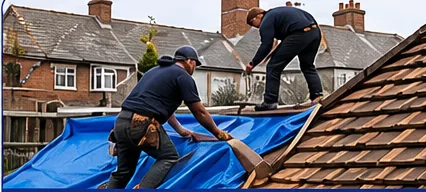
After a bad night of wind, a homeowner finds a few tiles on the lawn and a stain spreading across the bedroom ceiling. The obvious cause is the storm. The insurer may see it differently, because a roof that was already tired can lose tiles in a gale that a sound roof would shrug off. Whether a claim is paid often turns on one question: did the weather cause this damage, or did it simply reveal damage that was coming anyway? This guide explains how that line is drawn on a roof, what the physical evidence looks like, and how to give a claim the best honest chance.
What your policy is actually promising
Buildings insurance does not cover everything that goes wrong with a house. It covers named events, known as insured perils, and storm is usually one of them. It also lists exclusions, and the one that matters on a roof is the exclusion for wear and tear, along with gradual deterioration, rot, damp that builds up slowly and poor maintenance. Those are treated as the normal cost of owning a building, not as insurable accidents.
Policies differ, and so do their definitions. Many define a storm by the severity of the weather rather than by naming a number, and some do give a threshold. Some cover damage to fixtures such as aerials or fences only in particular circumstances. We cannot tell you what your policy says, and neither can anyone who has not read it. Find the wording for "storm", "wear and tear" and "maintenance", and read the section on what you must do when you discover damage. Your insurer decides what is covered; a roofer's job is to establish what physically happened and record it fairly.
If you want to understand the weather side first, our guide to what wind speed damages a roof explains how a gust interacts with a roof covering, and storm damage to roofs: what to do first covers the immediate steps.
How the line between storm and wear is drawn
The test an insurer applies is about cause. Storm damage is sudden and has a clear cause in a weather event. Wear and tear is gradual and has a cause in age, exposure and lack of upkeep. In practice the two overlap, which is why disputes happen. A gale does not damage a perfect roof, and it does not need to. The insurer's question is whether the roof's state before the storm explains the loss.
Think of a ridge tile bedded in old mortar that has been cracking for years. Wind lifts it and it falls. The storm was the trigger, but the cause was the failed bedding. An insurer may call that wear and tear. Now think of a sound, well-fixed tile that is struck by a branch and shatters. There is nothing in the roof's condition to explain it, and the cause is the storm. Most real cases sit somewhere between those two.
The timing matters as well. A leak that appears the morning after a named storm points towards an event. A ceiling stain that has been creeping for months, with a tide mark and a dark halo, points to slow failure, and the insurer may treat the storm as the moment you noticed rather than the moment it happened.
What the roof itself tells an assessor
A roofer or loss adjuster is reading physical evidence, and some of it is easy to see once you know where to look.
- Fresh versus old breaks. A tile broken by impact or wind shows clean, pale edges and may still lie where it fell. An old break is weathered, stained, mossed over or filled with debris.
- Cleanliness of the exposed area. Where a tile has just been lost, the batten and underlay beneath are clean and the felt unfaded. Where the covering has been missing for a while, they are dark, dirty or rotten.
- Direction. Storm damage tends to cluster on the windward slopes, edges, verges and ridges, where wind loads are highest. Random loss across every slope looks more like age.
- The fixings. Rusted nails, snapped clips and perished battens suggest a roof that had lost its grip long before the wind arrived. Bright, sound nails pulled out of good timber suggest force.
- Debris. A branch on the roof, a neighbour's fence panel in the garden or loose items down the street all point to a genuine event.
This is where an honest survey helps. We go up, look at the break edges, the fixings and the state of the battens, and photograph each of them so the record shows your roof as it is. We describe what we see, and we do not tilt the report either way. A report that overstates a case is no use to you, because an assessor will see through it and the claim loses credibility.
Why old roofs make claims harder
An old roof is not excluded from cover. It just has more evidence for the insurer to question. Roofs built in the 1960s and 70s often have concrete interlocking tiles on softwood battens and bitumen felt that is now brittle. Older clay or slate roofs may rely on hand-driven nails that have corroded over many winters. Mortar-bedded ridges and verges are common weak points on both.
Where a roof is mid-life and sound, a storm repair is usually a straightforward matter of replacing what the weather took. Where the underlying fixings have failed, an insurer may offer to repair only the part that was clearly storm-damaged, or decline if the loss is judged to flow from the deterioration. Either way, the roof still needs repairing, and the sensible way to treat it is as two questions: what is the immediate damage, and what is the condition of the rest. You can read how to price both in our guide to roof repair costs.
Maintenance has a part too. If gutters were left blocked and the fascia rotted, or moss was allowed to lift tiles, an insurer can argue that neglect contributed. Regular checks and small repairs are the best protection for a future claim, because they leave a record of a roof that was looked after.
Mixed cases deserve a careful split. Suppose a storm strips ten tiles from a slope and the survey shows the battens beneath are sound, while the rest of the slope has rusting nails and soft timber. The ten tiles are a storm repair. The remaining slope is a maintenance matter that you will face sooner or later. Putting the two on separate lines of the quote lets the insurer consider the first fairly and lets you plan for the second, without either hiding inside the other.
| What you see | Points towards storm | Points towards wear and tear |
|---|---|---|
| Missing tiles | Clean exposed battens, tiles found nearby, windward slope | Dark, rotten battens, scattered loss on all slopes |
| Ridge or hip failure | Sound fixings pulled out, fresh mortar breaks | Crumbling mortar, moss in the joints, long-cracked bedding |
| Ceiling stain | Appeared after the event, no tide marks | Layered tide marks, mould, soft plaster |
| Lifted flashing | Bright lead, torn from sound mortar | Corroded or split lead, failed sealant, open joints |
| Cracked tiles | Impact point, branch or debris present | Frost cracks, delamination, flaking surfaces |
Building the evidence for a claim
You do not have to prove a claim as if in court, but you do have to give the insurer something to work with. Start with the moment you find the damage. Photograph the inside and the outside from the ground, with a wide shot and close-ups, and note the date and the weather. Keep any fallen tiles or debris until the insurer has had the chance to see them, and photograph them where they lie. Do not go up on the roof to take photographs. It is not worth the risk, and a roofer can do it safely.
Notify the insurer promptly, because most policies expect to hear about damage within a reasonable time. Take reasonable steps to prevent further loss, such as a temporary covering, and keep every receipt. Our temporary roof repairs and tarpaulins guide explains what is reasonable, and what a good temporary job looks like. Then ask your roofer for a written report with dated photographs, a plain account of the cause, and a quote for the lasting repair. Our guide to what evidence your insurer needs after roof damage lists the full set.
If the insurer sends a loss adjuster, let them see everything. Honest answers about the roof's age and history are better than hopeful ones, because inconsistencies do more harm than an old roof.
If the insurer says no, or offers too little
A refusal on the grounds of wear and tear is not always the end. Ask for the reason in writing, and ask which part of the policy is relied on. If you disagree, you can send the insurer your roofer's report and photographs and ask them to reconsider. If it is still unresolved, the insurer must tell you about the complaints process, and you may be able to take the matter to the Financial Ombudsman Service. For general advice on your rights, citizens advice is a good place to start. We are not able to give legal or insurance advice, so please check your policy and speak to your insurer or an independent adviser.
Whatever the outcome of the claim, the roof still needs attention. A free survey from us shows the roof as it stands, with photos of your own roof, and a fixed written quote follows. Where a repair is enough we say so, and we put our 10-year guarantee on the workmanship in writing. More on the service sits on our page about emergency roof repairs across Basingstoke. You can reach us on 01256 213956, or send photos to the same number by WhatsApp. If an insurer has asked for a contractor2019s report on the cause, we can write one from what we find on the survey, describing the roof as it is and nothing more.0027
