
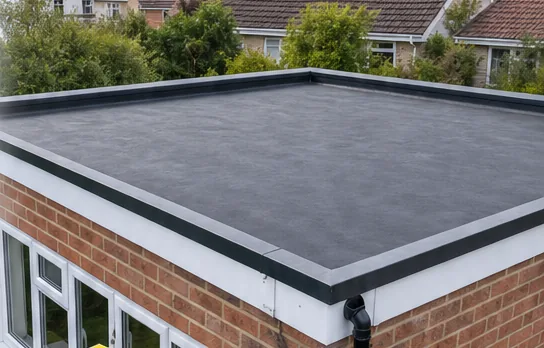
A flat roof is out of sight for most of the year, which is why the first sign of trouble is often a stain on a bedroom ceiling. By then water has usually been getting in for some time. The better approach is to know what failure looks like before it leaks, because most flat roof problems announce themselves early on the surface, at the edges or in the room below. This guide walks through those signs in the order you are likely to meet them, explains what is usually behind each, and says which ones can wait for a survey and which call for action sooner.
Water that stays on the roof
Look at the roof a day or two after rain. A slight dampness is normal. A defined pool, with a tide mark of silt or a ring of algae around its edge, is ponding, and it means the roof is not draining as designed. The cause is usually a fall that was too shallow to begin with, a deck that has sagged between joists, or an outlet that is blocked or set too high. Water that lingers adds weight, wears the surface, grows moss and puts every seam under constant test. Our answer on whether standing water is a problem explains how to tell a harmless puddle from a warning.
Ponding on its own is not a leak, and a roof can hold a pond for a while without letting water through. It is a sign the roof is ageing faster than it should, and it is one of the signs most worth acting on before the covering gives up.
Changes to the covering itself
Each material shows age differently, and the signs are specific enough to read.
Felt
Felt fails in recognisable ways. Fine cracks in a crazy-paving pattern across the surface show the bitumen has hardened. Bubbles, called blisters, form where moisture or air is trapped between layers, and a blister that has split lets water straight in. Bare patches where the mineral chippings have washed away expose the bitumen to sunlight. Laps (the overlaps between sheets) that have opened, and edges that have pulled away from the trim, are the places leaks tend to start. For a closer look at bubbling, see our answer on what causes blisters on a flat roof.
EPDM
EPDM is a single rubber sheet, so look at its joins and edges. A seam that has lifted, a sheet that has shrunk and pulled away from an upstand, a puncture from a dropped tool or a branch, and a surface that has turned chalky or brittle are the usual signs. Wrinkles are normal in a new sheet and are not a fault by themselves, but a sheet that is tight, drawn or torn at a corner is under strain.
GRP
GRP is a rigid laminate, so cracks are the signal. Fine hairline cracks in the topcoat along the board joints are common as a roof ages and are often cosmetic at first. Wider cracks, crazing across a whole area, patches where the gel coat has worn through to the glass fibres, and any place where the laminate has separated from the edge trim need attention, since the resin underneath is no longer protected.
Trouble at the edges and junctions
Most leaks begin at an edge, so it pays to inspect them. Look along the wall where the roof meets the house. The upstand, the covering turned up the brickwork, should be firm and the flashing above it should be tight. Gaps, lifted lead, cracked sealant or a flashing that has pulled out of a mortar joint all let water behind the covering.
Check the trim at the front edge, which guides water into the gutter. Water that overshoots the gutter, stains on the fascia below, and a trim that has loosened or dropped all suggest the edge is no longer doing its job. Around rooflights and vents, look for cracked mastic, a lifted collar or a kerb that has moved. Our answer on flat roof edge trims explains what they do and why they fail.
What you can see from inside the house
The room below the roof gives away what the surface hides. The signs, roughly in order of seriousness, are these:
- A faint brown or yellow ring on the ceiling that grows slightly after wet weather.
- Peeling or bubbling paint, or a patch that never quite dries, particularly where the ceiling meets the wall.
- A musty smell in the room that is hard to trace.
- Mould spots in the corners or along the cornice.
- A ceiling that sags, dips or feels soft to the touch.
- Drips during rain, or damp that appears around a light fitting.
Water travels along joists and pipes before it drips, so the stain is often not directly below the hole. If a stain appears, do not assume the repair belongs above it. A roofer should trace the water back along the likely route, and that is part of what a survey does.
Switch off a light fitting that is wet or beneath a stain and, if water is coming through near any electrics, treat it as an emergency. A bucket and a protected floor deal with the immediate drip. If the leak is active we prioritise emergency calls and will make a leaking roof safe first.
A soft or spongy deck
Stand or kneel on the roof carefully, if you can do so safely, or ask a roofer to check. A deck that gives or feels spongy underfoot has been wet for long enough for the board to lose strength. Plywood delaminates and OSB swells at its edges, and either can go soft well before the covering shows any damage. A soft deck changes the job entirely. The covering above it cannot be repaired in any lasting way, because there is nothing firm to stick the repair to, and the board has to be replaced.
The same applies to a roof that has a noticeable dip or a bounce in one area. That points to wet insulation or a rotted joist end, and it is a reason to book a survey sooner rather than later.
Moss, algae and plant growth
A green or black film on a flat roof is a sign that moisture is staying on the surface, and it often follows ponding or a blocked outlet. Moss in particular holds water against the covering, and its roots can lift the edges of felt and GRP topcoats. Weeds or seedlings growing in silt at the edge of the roof show where debris has built up and where drainage has failed. Clearing growth is easy, and a proper clean often reveals the real condition of the surface underneath, but regrowth means the cause, usually drainage or shade, has not been fixed.
Which signs can wait and which cannot
| What you see | What it usually means | How soon to act |
|---|---|---|
| Active drip or wet ceiling | Water is through the covering now | Make safe at once, then book a survey |
| Soft or bouncing deck | Wet or rotted boards beneath the covering | Survey soon, before the damage spreads |
| Split blister or open seam | Covering breached at a known weak point | Repair before the next wet spell |
| Standing water after several dry days | Lost fall or blocked outlet | Survey within the season |
| Hairline cracks or surface wear | An ageing covering, not yet breached | Monitor, and plan ahead |
| Moss or silt at edges | Debris and drainage problems | Clear and check the outlets |
Does one sign mean replacement?
Not necessarily, and this is where an honest survey earns its keep. A single failed upstand, a puncture or a blocked outlet is a repair job on a roof that may have many years ahead of it. A covering that is cracked, thin and worn over its whole surface, sitting on a deck that is wet in places, is a replacement job, and repairing it only postpones the cost. The difference between the two is not obvious from the ground. It shows when someone goes up, presses on the deck, looks at every junction and photographs the result. Our guide to flat roof repair or replacement sets out how we weigh it, while the lifespan guide helps put your roof's age in context.
A simple inspection routine
Once or twice a year, and after any severe storm, a short routine catches most problems early. From the ground or a window, look at the whole roof for pooling, debris, sagging lines and anything that has moved. Check the gutter and downpipe at the edge, since a blocked outlet is the cheapest problem on this list to fix and one of the commonest causes of the more expensive ones. Inside, look at the ceilings and the tops of the walls beneath the roof with a torch, including inside the cupboard or loft hatch if there is one. Take a dated photograph of anything that looks different from last time, because a change over months is far more telling than a single glance.
Keep the photographs. When a roofer visits, a record of when a stain first appeared and how it has grown saves time and helps separate a slow weep at a junction from a sudden failure. It also helps if the roof is under a guarantee, or if you are selling the house and a buyer's surveyor asks about the roof's history.
What we do when you ring
Our survey is free, and it is carried out on your own roof rather than from a description. We check the covering, the deck, the falls, the outlets, the edges and each junction, and you receive photographs with a plain account of what is wrong. If the roof can be repaired, the quote is for the repair. If it needs replacing, you get a fixed written quote for that. New work carries a written ten-year guarantee on our workmanship, and we take the rubbish with us. You can read more about the work on our flat roofing in Basingstoke page, or reach us on 01256 213956, by WhatsApp or through the contact form.
