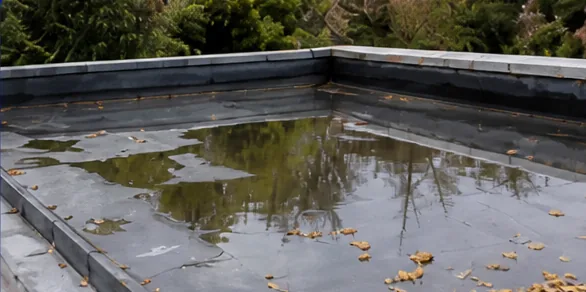
Nobody can give you one number for how long a flat roof lasts, and anyone who does is guessing. The same EPDM sheet can serve a sheltered kitchen extension for a very long time and give up early on a roof that holds water under an oak tree. What we can tell you is what decides the outcome. Four things matter most: the covering you chose, the quality of the deck and falls underneath it, how well the edges and junctions were formed, and whether anyone has looked after the roof since it was laid. This guide takes those four in turn, then explains how we judge the remaining life of a roof when we survey it.
The covering sets the ceiling
Every flat roof material has a natural limit, and the other factors decide how close to it you get. Reinforced bitumen felt is the shortest-lived of the three common coverings. Modern felt is a different product from the thin single layer that gave flat roofs a bad name in the 1970s, but it is still bitumen, and bitumen slowly hardens and cracks as sunlight and frost work on it. EPDM, a synthetic rubber sheet, does not suffer from that hardening in the same way, because the polymer is made to resist ultraviolet light and ozone. GRP, a glass-reinforced plastic laminate, forms a hard shell that does not rely on joints between sheets.
Of the three, felt generally has the shortest life, and EPDM and GRP last considerably longer when properly laid and maintained. We stop short of quoting a precise number of years for each, because manufacturers' stated lives are given for ideal conditions and a roof in a Hampshire back garden is rarely ideal. Our comparison of EPDM, GRP and felt sets the three side by side on cost and repair as well as life, and the guide to choosing the best flat roof material explains which suits which shape of roof.
Liquid-applied coatings and lead sit outside that ranking. A liquid coating on a sound roof can add useful time, but it is only as good as what lies under it. Lead, where it has been used on period bays and porches, can outlast the building's other finishes if it is detailed to allow for thermal movement.
The deck and the falls matter as much as the membrane
A covering is a skin, and a skin is only as good as the body beneath. The deck is the board layer the covering is stuck to, usually boards or sheets of OSB or plywood laid over timber joists. If the deck is rotten, the best membrane in the world is sitting on a soft surface that flexes under foot and tears at the fixings.
The falls are the slope that carries water to the outlet. A roof laid with too little fall holds a skin of water after every shower, and a roof that has sagged over the years holds deeper ponds. Standing water does three things. It adds weight to the deck, it keeps the surface wet long enough for algae and moss to take hold, and it tests every seam and upstand constantly instead of occasionally. Our answer on standing water on a flat roof explains when a puddle is harmless and when it is the start of a short life.
Insulation and ventilation affect the deck too. In a cold roof, where insulation sits between the joists with an air gap above, warm moist air from the house can condense on the cold underside of the deck and rot it from beneath. The roof looks fine from above while the timber quietly decays. A warm roof, with insulation above the deck, keeps the structure warm and dry, which is one reason it is the usual choice when a covering is replaced.
Edges, upstands and outlets: where early failures start
When a young flat roof fails, the field of the membrane is rarely the culprit. The failure begins at an edge. Think of the places where the covering has to change direction or stop: the upstand where it turns up a wall, the flashing that laps over that upstand, the trim at the roof edge that guides water into the gutter, the collar around a soil pipe, the kerb around a rooflight. Each is a joint made by hand on site, and each is exposed to movement.
An upstand taken too low lets rain splash behind the covering. A flashing set into soft mortar loosens when the mortar crumbles. An edge trim fixed without a drip lets water track back under the membrane. An outlet bedded without a proper seal weeps for a winter or two and then lets go. These are workmanship faults rather than material faults, and they explain why two roofs of the same material can have very different lives. They are also the reason a repair at a single junction can add real years to an otherwise sound roof.
Sunlight, trees and foot traffic
The setting does a good deal of the damage. A roof facing south takes more ultraviolet light and a wider temperature swing than one shaded by a taller neighbour, and the swing is what wears the surface: it expands in the afternoon sun and contracts overnight, season after season. A roof under deciduous trees gets the opposite treatment. Leaves block the outlet, moss grows in the debris, and branches drop twigs onto the surface. Under an oak, sycamore or horse chestnut the roof needs clearing at least once each autumn, and a roof that never gets cleared will age faster than any manufacturer expects.
Foot traffic is the other quiet killer. A roof designed to be looked at once a year is not built for regular visits to clean windows, store garden furniture or retrieve a football. Grit under a shoe can scratch a GRP topcoat and puncture an EPDM sheet. If the roof is walked on, a proper walkway or a raised deck over the membrane protects it. Our short answer on whether you can walk on a flat roof covers what each material tolerates.
What maintenance actually extends the life
Maintenance on a flat roof is dull and cheap, which is why it is skipped. The jobs that pay back are these:
- Clearing leaves, silt and moss from the surface and outlets, at least once a year and after a storm.
- Checking the gutter at the roof edge, since a blocked gutter backs water onto the covering.
- Looking at the upstands and flashings for gaps, lifting edges or cracked sealant.
- Looking at the underside from inside, in the ceiling and at the wall plate, for stains, dark patches or a musty smell.
- Keeping heavy items, paving slabs and sharp objects off an unprotected membrane.
None of that needs specialist skill, though going up on a roof carries its own risk and you should only do so if you can do it safely. Anything you cannot reach from a stable position is a job for a roofer. What you should not do is let moss and debris build for several years and then apply a coating over the top, because the coating will seal the problem in.
Signs a roof is coming to the end of its life
A roof usually gives warning. On felt, look for cracking in a pattern like crazy paving, bubbles that have split, bare patches where the mineral chippings have washed off, and edges where the felt has pulled away from the trim. On EPDM, look for seams that lift, shrinkage pulling the sheet away from an upstand, punctures, and a chalky or brittle surface. On GRP, look for fine hairline cracks in the topcoat, especially along the joints between boards, and for patches where the colour has faded and the glass fibre weave shows through.
Inside the house, a brown ring on the ceiling that grows after rain, a damp smell, peeling paint at the junction of ceiling and wall and a sagging ceiling board all point to water getting in, often for some time before the first drip. Our guide to the signs of flat roof failure goes through these in more detail and explains what each one usually means.
| Covering | What usually limits its life | What extends it |
|---|---|---|
| Reinforced felt | Bitumen hardening, splitting at laps and edges | Mineral cap sheet, good edge detail, keeping it clear |
| EPDM | Puncture, failed adhesive at seams and upstands | Single sheet, protected walkway, clean outlets |
| GRP | Deck movement cracking the laminate, topcoat wear | Sound deck, flexible resin, topcoat refreshed when worn |
| Lead | Fatigue from thermal movement if rolls are too long | Correct sheet size and laps, sound timber below |
Repair, overlay or replace: how we judge remaining life
When we survey a flat roof we are really answering one question: is this a roof with years left that has one fault, or a roof at the end of its life that has many? We go up and press on the deck to find soft spots. We look at the falls, the outlets and every junction. We check the covering for splits, blisters and wear, and we take photographs so you see your own roof. Where we can reach the underside, we look for staining and decay.
If the deck is sound and the covering is basically healthy, a repair at one upstand or a replaced outlet can be the honest recommendation, and we say so. If the covering is worn out but the deck is dry and sound, a new covering on the existing deck is a fair price for what you get. If the deck is wet or rotten, the covering has to come off and the timber has to be dealt with, and it makes little sense to pay for a repair on top. Our guide to repairing or replacing a flat roof sets out that decision in full.
It is worth remembering one practical point about the cost of delay. A repair on a failing covering buys time, but the water that gets in before you notice does its damage to timber and insulation regardless. The point to act is usually before the ceiling shows a stain, not after.
Getting your own roof assessed
If you want to know where your own roof stands, our free survey is the starting point. We photograph what we find, explain it in plain terms and give you a fixed written quote if work is needed. Where a roof has life left we will tell you, and where it does not we will explain why. Anything we then build is covered by a written guarantee on our workmanship that runs for ten years, and the old covering leaves with us. The wider picture of our work on these roofs is on the flat roofing in Basingstoke page. Booking a visit takes one call to 01256 213956, and a WhatsApp works as well.
