
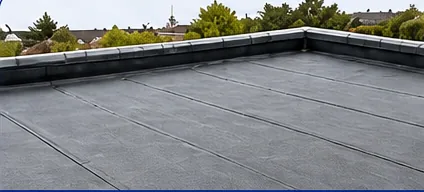
Walk round an industrial estate built before the 1990s and you will see the same grey, ribbed sheeting on unit after unit. A good share of it is asbestos cement: cement reinforced with asbestos fibre, pressed into big corrugated sheets that were cheap, light and long-lasting. A commercial asbestos roof is not an emergency just because it is there. Left intact and in fair condition, the fibres are locked into the cement. The trouble starts when sheets crack, weather badly, get drilled, or are hit by a fork-lift or a careless contractor. This guide explains who is responsible, how we survey, and what the sensible options are.
What asbestos cement sheeting looks like on a commercial roof
Asbestos cement sheets, often called AC sheets, were used for roofs and for wall cladding on factories, depots, garages, storage barns and large sheds. They come in long corrugated profiles bolted to steel purlins (the horizontal rails that carry the roof) with hook bolts and shaped washers, and the ridge is capped with a matching sheet. Over the years the surface turns green or black with algae and lichen, and the fixings rust where the sheet meets them.
You cannot identify asbestos by looking at it. Plenty of fibre cement sheets made without asbestos look identical, and a roof may carry a mixture of old and replacement sheets from different decades. Only a sample analysed by a laboratory settles it, which is why a survey by a qualified asbestos surveyor comes before any decision. We do not guess from the colour of the sheet, and neither should anyone quoting you for the work.
Other asbestos materials can sit around the roof too. Insulating board used for soffits and fire stops, asbestos-based gutters and downpipes, flue pipes and bitumen-based roof coverings may all be present, and each is treated differently from cement sheet. That matters later, when we look at the options.
The duty to manage on non-domestic premises
For commercial, industrial and shared buildings, the law places a duty on whoever is responsible for the maintenance or repair of the premises to manage asbestos in them. That person may be the owner, a landlord, or a tenant whose lease makes them responsible for repair. The HSE guidance on its website sets out what the duty holder needs to do, and it is worth reading it directly at hse.gov.uk/asbestos. We are not giving legal advice here, and if you are unsure whether the duty falls on you or your landlord, the lease and the HSE guidance are the places to look.
In practical terms, managing asbestos means finding out whether it is present, assessing its condition, recording where it is, deciding how to deal with it, and passing that information to anyone who might disturb it. For a roof, that last point is the one that catches people out. A telecoms engineer fixing an aerial, a solar installer drilling for brackets, or an electrician running cable across the sheets can all damage them if nobody told them what they were standing on.
If you rent a unit, ask who holds the asbestos register and when the roof was last inspected. Questions about who pays for roof repairs under a commercial lease are covered in our guide to landlord or tenant roof repairs, which is a separate matter from who carries the duty to manage.
How we assess an asbestos cement roof
Our survey is the free one we offer on any roof, with photographs of your own building, and with asbestos cement it has one extra rule: we do not put anyone on the sheets. AC sheets become brittle with age and can fail under a person's weight, which makes them fragile in the same way a rooflight is. Our guide to fragile roofs and safe access covers the access side, and the same principles apply here. We inspect from a mobile elevated work platform, from the eaves, from inside the building and, where it suits, with a drone, looking at the sheets from a safe position.
What we are looking for is condition. Sheets with surface weathering, moss and light staining are common and not in themselves a danger. Sheets with cracks across the corrugations, broken corners at the laps, holes around fixings, or sagging between purlins are a different matter. We note where daylight shows through, where water is coming in, and whether previous repairs used materials that might themselves contain asbestos. Inside, a roof that drips onto stock or machinery tells us the sheets or their laps have already gone.
The photo report shows each of those findings on your roof, mapped to the building, so that you, your surveyor and your insurer can all see what is there. If an asbestos register already exists, we read it first. If it does not, we tell you plainly that a laboratory sample and register come before any work that disturbs the sheets.
Removal: what HSE says about non-licensed work
Many people believe that taking off an asbestos roof always needs a specially licensed contractor. According to HSE guidance, that is not quite right. The careful removal of asbestos cement roof sheets, taken off whole without breaking them, is classed as non-licensed work. Non-licensed does not mean casual. A risk assessment, proper controls and workers trained for the task are always needed, along with a plan for wrapping, labelling and carrying the sheets away to a waste site that accepts them.
The category changes if the material is going to be substantially broken up, for example when a roof is stripped by dropping sheets to the ground or smashing them into skips. That becomes notifiable non-licensed work, meaning the enforcing authority has to be told before the job starts, and more controls apply. You can read the current position on the HSE non-licensed work page.
Why does this matter to a building owner? Because price and method follow the category. A roof that can be unbolted sheet by sheet, lowered by a hoist and wrapped on the day is a different job from one where the sheets have fused to rusted fixings and will snap on the way off. We say honestly which one yours looks like, and we say so before you sign anything, because a fixed written quote has to be based on the method that will really be used.
Removal also exposes the building. Once the sheets are off, the steel structure, the purlins and anything stored beneath are open to the weather, so a re-roof usually follows straight on: a new insulated profiled sheet or composite panel system, with the work sequenced so that the building is never left open overnight. Waste is taken away from site, and the site is cleared when the job is done.
Overcladding and other alternatives to stripping
Removal is not the only answer. HSE task guidance for small structures such as garages suggests overlaying as an alternative to taking the asbestos cement sheets off. On a commercial building, the equivalent is overcladding: fixing a new weathertight roof system over the existing sheets, so the old roof stays in place beneath it and is not disturbed.
It works when the old sheets are sound enough to carry the new fixings and the extra load. The new layer usually sits on top of a system of support brackets and rails, fixed through the old sheets into the purlins. That fixing step is where care is needed, since drilling or fixing through AC sheets creates dust and needs controls. Overcladding also raises the insulation question, because a new roof over an old one is a chance to bring thermal performance up, and it changes the weight on the structure, which a structural engineer should check. Our guide to overcladding a commercial roof goes into the method, and our answer page on whether you can overclad an asbestos cement roof covers the key points quickly.
Overlaying has limits. It does not suit sheets that are crumbling, badly cracked or sagging, because they cannot take fixings safely. It does not apply where other asbestos materials, such as insulating board, are present, since the guidance covers cement sheets specifically. And it leaves the problem in the building for the next owner, so the asbestos register and the lease or sale paperwork have to carry the information forward. Stripping removes the material for good, while overcladding is often quicker, cheaper and less disruptive to a trading business.
| Condition of the sheets | Usual direction | Main consideration |
|---|---|---|
| Sound, weathered, no leaks | Leave, record and monitor | Keep the register current and warn anyone working on the roof |
| Isolated cracks or loose fixings | Targeted repair or local sheet replacement | Work must not break or drill sheets without controls |
| Generally sound but leaking at laps | Overcladding | Structure must carry the new system; fixings need controls |
| Brittle, sagging or crumbling | Careful removal and re-roof | Method decides whether the work is notifiable |
| Other asbestos materials present | Specialist advice before anything else | Overlaying guidance for cement sheets may not apply |
Building regulations and what a new roof must achieve
Replacing a large commercial roof is rarely just a like-for-like swap. A new covering on a building is subject to the rules on thermal performance, and the roof counts as a thermal element, so a re-roof that touches enough of the building often requires the insulation to be upgraded as well. Weight is the other trigger: a replacement that adds 15% or more to the load on the structure needs approval and perhaps strengthening, which is worth knowing because insulated composite panels weigh more than a single skin of AC sheeting. Fire performance and rooflight areas need thought too. Our guide to building regulations for commercial roofs sets out the questions to ask. Where the job is notifiable we handle the paperwork with building control, and the body you choose confirms what applies to your premises.
Choosing a route, and what to ask any contractor
The right route depends on the condition of the sheets, the plans for the building and the budget. If you intend to sell or redevelop within a few years, a managed roof with a current register and a sound repair might be enough. If the roof is the cause of leaks and the business cannot afford further disruption, overcladding or a planned strip with a new roof is more sensible than repeated patching.
Whoever you ask, there are questions worth putting. Which material have the samples confirmed? Is the work classed as non-licensed or notifiable, and why? What controls and trained workers will be on site? Where will the waste go? How will the building be kept weathertight during the work? A contractor who cannot answer those clearly should not be touching your roof. Our approach is to show you the condition of the roof in photographs first, then give you a fixed written quote for the route we recommend, and to say so where repair is all that is needed. The finished work is backed by a written workmanship guarantee that runs for ten years. To book a survey, return to our commercial roofing in Basingstoke page, call 01256 213956 or send us a WhatsApp.
