
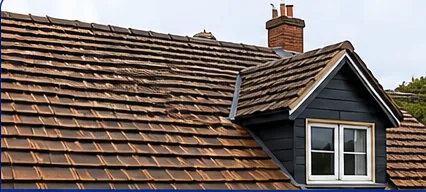
Planning permission is the council's control over what is built and how it looks. It is separate from Building Regulations, which are about whether the work is safe and efficient, and the two are easy to confuse. Most ordinary roof work is outside the planning system altogether: mending slipped tiles, renewing a ridge, re-covering in the same material or fitting new felt are maintenance, and nobody needs permission to maintain a roof. The questions start when the work changes how the building looks or when the building is protected. This guide separates the cases, so you know which ones to ask about. It is general guidance for England, not legal advice, and the council's planning team is the body that gives the definite answer for your address.
A shorter page deals with the ordinary house re-roof and asks whether a new roof needs planning permission; this one also takes in conservation areas, listed buildings and flats.
Work that normally needs no planning permission
Repair and like-for-like replacement of a roof covering is not usually development in planning terms. That covers replacing missing or broken tiles and slates, renewing flashings, re-bedding or replacing ridge and hip tiles, renewing felt and battens, replacing a section of flat roof with the same type of covering, and repairing a chimney stack. The same goes for gutters, fascias and soffits replaced in the same style. Materials of a similar appearance are acceptable. A new covering that looks very different from the old, such as swapping clay tiles for a bright grey slate effect on a visible slope, can raise a question if the building is protected, which is why the next sections matter.
The difference between planning and Building Regulations
A full re-roof may need Building Regulations approval, depending on how much of the roof it affects, without needing planning permission at all. A new dormer may need both. A roof window may need neither, one or both. Our guide to Building Regulations for roofing work covers the second set of rules, and this page covers the first. It is common to get one right and forget the other, and an application to the wrong body gets nowhere.
Work that may need planning permission
Changes to the form of the roof are the usual triggers. Raising the ridge, altering the pitch, adding a dormer, building a roof extension, changing a hip to a gable, converting a flat roof to a pitched one, and adding a balcony or roof terrace are all matters the council may want to see. Many householders have permitted development rights, which allow certain changes without a planning application provided limits on size, position and materials are met. Those limits are detailed and have exceptions, and for loft and roof extensions they are tighter than people expect. We do not summarise them here, because a half-remembered rule is worse than none. Check with your council's planning team, or the national guidance service, the Planning Portal, before you commission drawings.
Roof windows and rooflights
Fitting a roof window or rooflight into an existing roof is covered by a specific permitted development class, with limits on how far it projects, how high it sits and, on side slopes, how it is glazed. Those rules, and the exceptions for flats and protected areas, are set out in full in our roof windows hub and in the guide on whether you need planning permission for a skylight. We link to them in place of repeating them here.
Solid roofs on conservatories
Swapping a glass or polycarbonate conservatory roof for a solid tiled one raises a Building Regulations question first, as the frame has to take the load. Planning is a separate issue, and depends on the size and position of the structure and your rights. Our pages on conservatory roof planning permission and conservatory roof Building Regulations deal with each.
Flat roofs, garages and outbuildings
Re-covering a flat roof in a similar style needs no planning permission. Turning it into a terrace, adding a balcony or raising its parapet can. Garages and outbuildings are affected by rules on height and distance from boundaries, and conversion to living accommodation raises other questions. Our guides on whether a flat roof needs planning permission and garage roof planning permission go into the detail.
Chimneys
Repairing a chimney is maintenance. Removing a chimney stack, wholly or partly, can be a different matter depending on the building, and in some places the stack is part of the character that planning is protecting. Our answer on planning permission to remove a chimney explains the position.
Listed buildings
A listed building is controlled much more tightly. Listed building consent is a separate permission, and it applies to alterations that affect the character of the building, which can include changes to the roof covering, even where the same work would be maintenance on any other house. Mending what is there in the same material is usually accepted, whereas a different material or look can call for consent. Historic England publishes guidance, and the council's conservation officer is the person to ask before any work is planned. Our answer on roof work on a listed building gives more. Using the wrong material or the wrong method on a listed building is an offence, so ask first.
Conservation areas and Article 4 directions
Conservation areas protect the character of whole streets and villages. Around Basingstoke, places such as Old Basing, Worting and Kingsclere have designated conservation areas, and parts of the town centre are protected too. In these areas permitted development rights are narrower, and visible changes to a roof, such as new windows on a front slope, a change of covering or an altered chimney, may need permission. An Article 4 direction goes further, withdrawing some rights that would otherwise apply, in a defined area. Whether your street is covered is something the council can tell you. Our answer on roof work in a conservation area explains what to ask, and the council may also advise on suitable materials.
Flats and maisonettes
Permitted development rights that apply to houses often do not apply to flats and maisonettes, so work that would be allowed on a house may need permission on a flat. And in a flat the roof is usually the freeholder's, with the lease setting out who may do what and who pays. Our answer on who pays for a shared roof covers the cost side.
Neighbours, party walls and wildlife
Even where no permission is needed, other rules may apply. Work on a wall or chimney shared with a neighbour can involve party wall notices, which is a civil matter separate from planning. Our answer on party walls and roof work sets it out. Nesting birds and bats are protected, and work may need to be timed or surveyed first.
Conditions that may already apply to your house
Many houses on newer estates were built under a planning permission that carried conditions, and some of those removed permitted development rights, so that alterations the rules would otherwise allow need an application. A condition might restrict roof extensions, require the original tile type to be kept, or forbid changes at the front. The conditions are in the original decision notice, which your solicitor should have seen at purchase, or the council can supply a copy. If your house is on an estate such as Hatch Warren or Chineham, it is worth checking before you plan a dormer or a change of covering.
Typical cases, in short form
- Replacing worn concrete tiles with the same type: no planning permission.
- Replacing the covering on a listed cottage with a different material: listed building consent needed.
- Re-felting and relaying slates on a house in a conservation area, same slate: usually no application, but confirm.
- Adding a rear dormer to a semi: likely to need permission or a check against permitted development limits.
- Fitting a roof window on a rear slope of a detached house: often permitted, with limits.
- Reroofing a block of flats: a freeholder matter and, depending on the work, perhaps planning.
Making an application
If you need permission, an application goes to the local planning authority, with plans of the existing and proposed roof, a location plan and a fee, usually through the Planning Portal. The council consults neighbours, considers the effect on the street and decides within a set period, often several weeks. Some councils offer a pre-application service for an opinion before you commit to drawings. It costs a fee but can save a refusal. A refusal can be appealed, though a modified scheme is often quicker. Start well ahead of the date you want the roofers, because scaffold and materials are easier to book once the decision is in your hand.
Common mistakes
The first is assuming that Building Regulations approval covers planning, or the other way round. The second is trusting a verbal reassurance from a builder who will not be there when the council writes. The third is starting work in a protected area on the strength of a neighbour having done the same, because their work may have had consent, or been caught later. The fourth is forgetting the freeholder in a flat. The fifth is changing the roof shape in a way that creeps past the permitted limits, a few centimetres at a time. Written confirmation from the council protects you from all of them.
How to find out for certain
Ask the council. Basingstoke and Deane Borough Council, like other councils, has a planning team that answers questions, and it can issue a formal certificate confirming that a proposed use or development is lawful. That certificate is useful as a record and later when you sell. For a roof in a neighbouring authority, such as Hart or Test Valley, the same applies. Describe the work, give the address and ask whether permission is needed. Keep the reply.
What your roofer should tell you
A good roofer should say at the quote whether the job looks like maintenance or something more, and whether your house is in a conservation area or listed. If the job changes the look of the roof, say so, and propose asking the council before work starts. The risk of getting it wrong is an enforcement notice, a forced reversal and difficulties at sale.
When we survey a roof, we tell you straight whether we think a job is ordinary maintenance, and where it is not, we say who to ask. The survey is free, the quote is fixed, and what we fit is guaranteed in writing for a decade. Take a look at our homepage, or ring 01256 213956 with your address.
